



View on Amazon
Product description


1 Two Way switch
2 IR Control


4K@60Hz HDMI KVM Switch Review: A Versatile 4-Computer Solution for Displays, USB Devices, and Audio
Managing several computers from one workstation can become complicated when every system needs its own keyboard, mouse, monitor connection, USB accessories, and audio equipment. A KVM switch can simplify that setup by allowing multiple computers to share the same collection of peripherals.
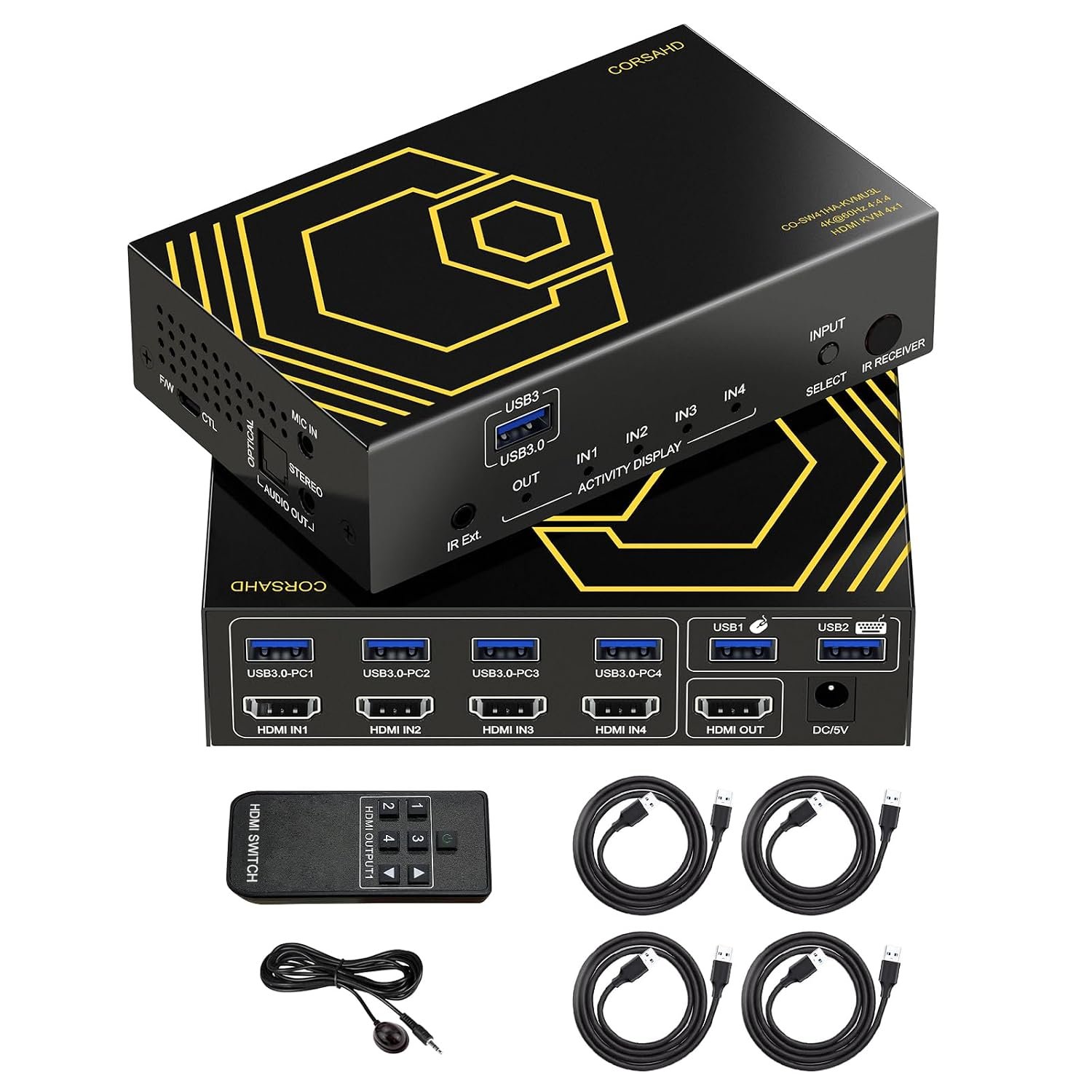
This 4K@60Hz HDMI KVM Switch is designed for users who need to connect up to four computers to a single monitor while sharing USB 3.0 devices and multiple audio connections. With HDMI 2.0 support, high-resolution video formats, USB 3.0 connectivity, SPDIF and analog audio outputs, microphone support, and IR remote control, it provides a flexible solution for multi-computer workstations.
One Monitor for Up to Four Computers
The main purpose of this KVM switch is to allow up to four computers to share one monitor and a common set of peripherals.
Instead of having separate keyboards, mice, USB devices, and display connections for every computer, the KVM provides a centralized setup. Users can connect their compatible systems to the switch and then select which computer they want to control.
The switch supports keyboard and mouse sharing along with USB devices, audio equipment, and a single monitor. This can be particularly useful for workstations where several computers are used throughout the day.
Whether the computers are being used for different tasks or simply need to share the same desk setup, the KVM helps reduce the need to repeatedly unplug and reconnect accessories.
4K@60Hz HDMI 2.0 Video Support
The HDMI 2.0 design supports several video formats, giving users flexibility across different monitor configurations.
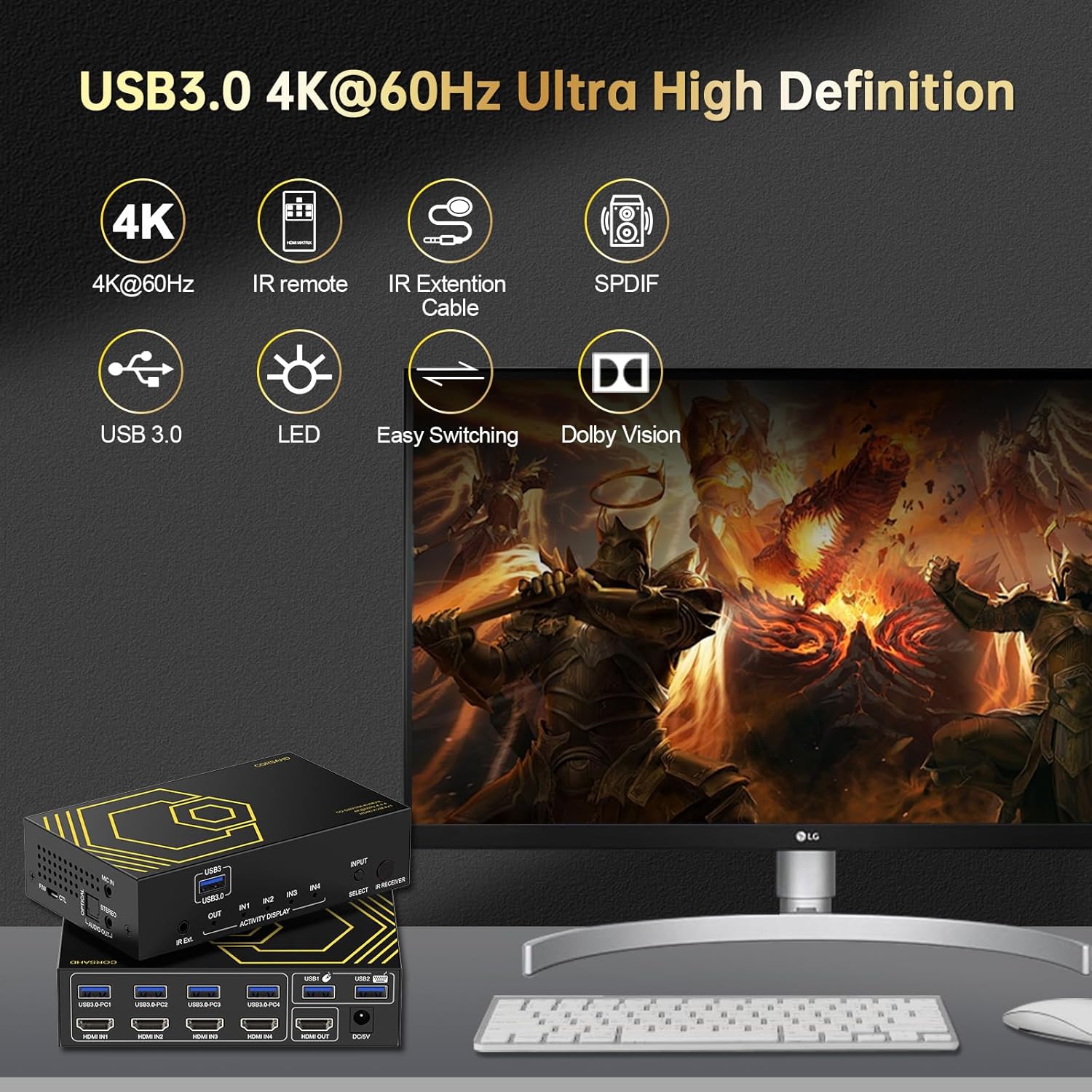
The switch supports 1080p at up to 144Hz, 2K at up to 144Hz, and 4K at up to 60Hz with RGB 4:4:4 and 8-bit HDR. It also supports Dolby Vision.
For users working with high-resolution displays, 4K@60Hz provides a detailed viewing experience while maintaining a smooth 60Hz refresh rate. The support for higher refresh rates at 1080p and 2K can also make the KVM suitable for setups where smoother motion is important.
The inclusion of RGB 4:4:4 support is particularly useful for users who need clear image reproduction and sharp text on a connected display.
The KVM also supports HDR and Dolby Vision, adding compatibility with advanced video formats within supported equipment and content.
High-Speed USB 3.0 Connectivity
The switch includes four USB 3.0 ports for sharing compatible peripherals between the connected computers.
These ports can recognize both wired and wireless keyboards and mice, USB flash drives, printers, and other USB devices. This makes the KVM more versatile than a basic display switch because it can serve as a central connection point for multiple peripherals.
USB 3.0 provides data transfer speeds of up to 5Gbps, which is considerably faster than USB 2.0’s stated 480Mbps transfer rate. The ports are also backward compatible with USB 2.0 and USB 1.1 devices.
This combination makes the switch suitable for users who have a mixture of newer and older USB equipment.
For example, a workstation could use the KVM to share input devices and storage accessories between multiple computers without requiring every computer to have its own dedicated set of peripherals.
Flexible Audio Connectivity
One of the more interesting features of this KVM is its range of audio connections.
It includes an SPDIF optical digital audio port supporting 5.1-channel audio, a 3.5mm L/R stereo audio connection, and a microphone jack.
The SPDIF and L/R stereo audio outputs can separate audio independently to a speaker system or amplifier without requiring the audio connection to pass through the TV or monitor.
This provides additional flexibility for users who have dedicated audio equipment in their workstation or entertainment setup.
The supported audio formats include DTS HD, Dolby TrueHD, and Dolby Atmos, making the switch suitable for setups where high-quality digital audio compatibility is important.
Convenient Switching Options
Switching between connected computers is designed to be straightforward.
The KVM supports switching through the physical button on the device as well as an IR remote control. The remote can be particularly useful when the KVM itself is positioned somewhere that is difficult to reach.
For example, the switch can be placed in a hidden or distant location while the user keeps the desktop area more organized. The IR remote allows computer selection without requiring the user to physically reach the KVM.
This can be especially convenient in larger workstations or setups where cable management is a priority.
One important point to remember is that this model does not support hotkey switching. Users should therefore rely on the supported physical button and IR remote methods rather than expecting keyboard shortcuts to change computers.
Designed for Organized Workstations
A major advantage of a KVM switch is the ability to reduce clutter.
When four computers share one monitor and common USB peripherals, the number of devices that need to remain directly connected to the desktop can be reduced. Instead of having multiple keyboards, mice, and other accessories competing for space, the KVM creates a centralized connection system.
This can be useful in professional environments, home offices, technical workstations, and other setups where several computers need to be accessible from one location.
The remote-control capability adds another level of convenience by allowing the KVM itself to be positioned away from the main working area.
Useful for High-Resolution and Multi-Computer Setups
The combination of 4K@60Hz HDMI support and USB 3.0 makes this KVM suitable for users who want both high-quality display output and fast peripheral connectivity.
The ability to support 1080p@144Hz and 2K@144Hz also gives the switch flexibility for different display requirements. Users don’t have to limit their setup to a basic 1080p@60Hz configuration.
At the same time, compatibility with HDR, Dolby Vision, and several advanced audio formats expands its usefulness beyond simple office productivity.
The result is a KVM that can serve multiple purposes depending on the connected computers and equipment.
Important Installation Considerations
There are a few specifications users should keep in mind before setting up the switch.
The manufacturer recommends using standard HDMI 2.0 cables shorter than 3 meters. Following this recommendation can help ensure that the connected display setup operates according to the intended specifications.
It is also important to remember that this model does not provide hotkey switching. Computer selection is handled through the supported switching methods, including the KVM button and IR remote.
Understanding these requirements ahead of time can help users plan their workstation and avoid expecting features that the device does not provide.
Final Verdict
This 4K@60Hz HDMI KVM Switch is a practical option for anyone who needs to manage multiple computers from one monitor and shared set of peripherals.
Its ability to connect up to four computers, combined with HDMI 2.0 video support, USB 3.0 connectivity, and extensive audio options, gives it a versatile feature set. Support for 4K@60Hz, 2K@144Hz, 1080p@144Hz, RGB 4:4:4, HDR, and Dolby Vision makes it suitable for a variety of display environments.
The four USB 3.0 ports add useful peripheral-sharing capabilities, while SPDIF, stereo audio, and microphone connections provide additional flexibility for users with dedicated audio equipment.
The IR remote is another convenient feature, particularly for users who want to keep the KVM hidden or positioned away from the main workspace.
Overall, this KVM switch offers a centralized and flexible way to bring four computers into a single-monitor workstation. For users who prioritize high-resolution HDMI output, fast USB connectivity, shared peripherals, and versatile audio support, it provides a well-rounded solution for managing multiple systems from one organized setup.