
“Quinn evocatively balances the outward cheerfulness of the 1950s with historical observations exploring racism, misogyny, homophobia and political persecution in this sharply drawn, gripping novel.” – People Magazine
The New York Times bestselling author of The Diamond Eye and The Rose Code returns with a haunting and powerful story of female friendships and secrets in a Washington, DC, boardinghouse during the McCarthy era.
Washington, DC, 1950. Everyone keeps to themselves at Briarwood House, a down-at-the-heels all-female boardinghouse in the heart of the nation’s capital where secrets hide behind white picket fences. But when the lovely, mysterious widow Grace March moves into the attic room, she draws her oddball collection of neighbors into unlikely friendship: poised English beauty Fliss, whose facade of perfect wife and mother covers gaping inner wounds; policeman’s daughter Nora, who finds herself entangled with a shadowy gangster; frustrated baseball star Beatrice, whose career has come to an end along with the women’s baseball league of WWII; and poisonous, gung-ho Arlene, who has thrown herself into McCarthy’s Red Scare.
Grace’s weekly attic-room dinner parties and window-brewed sun tea become a healing balm on all their lives, but she hides a terrible secret of her own. When a shocking act of violence tears the house apart, the Briar Club women must decide once and for all: who is the true enemy in their midst?
Capturing the paranoia of the McCarthy era and evoking the changing roles for women in postwar America, The Briar Club is an intimate and thrilling novel of secrets and loyalty put to the test.
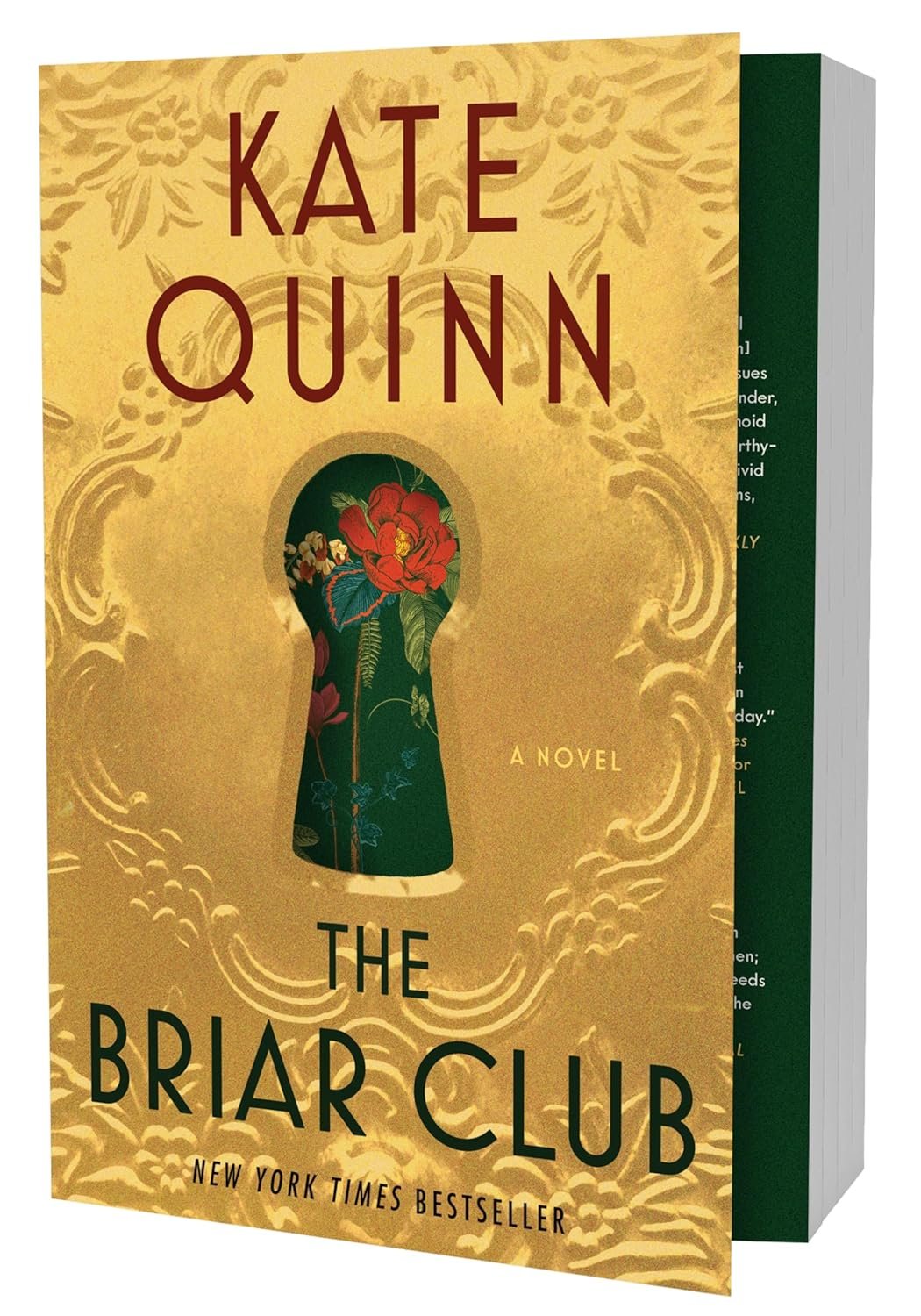
A beautiful, foil cover, first edition.
From the Publisher
View on Amazon


The Briar Club Review: A Gripping Story of Friendship, Secrets, and Suspicion
The Briar Club by Kate Quinn is a haunting and atmospheric historical novel that explores friendship, secrecy, loyalty, and the complicated realities of life for women in postwar America. Set in Washington, DC, in 1950, the story takes readers into Briarwood House, an all-female boardinghouse where a seemingly ordinary group of women gradually becomes connected through unexpected friendships and deeply buried secrets.
Against the backdrop of the McCarthy era and the growing paranoia surrounding the Red Scare, The Briar Club creates an intimate setting where personal relationships become just as important as the larger political tensions surrounding the characters.
A Fascinating Historical Setting
One of the novel’s strongest elements is its setting. Washington, DC, in 1950 provides a compelling backdrop for a story filled with uncertainty and suspicion.
The novel captures a period when American society was changing rapidly after World War II. The changing roles of women, political persecution, and social tensions all contribute to an atmosphere where appearances can be misleading.
Briarwood House becomes the perfect setting for this story. Behind its white picket fence is a group of women with very different personalities, experiences, and ambitions. Although they initially keep to themselves, their lives become increasingly intertwined.
This creates an engaging contrast between the seemingly cheerful surface of the 1950s and the darker realities hidden underneath.
An Intriguing Group of Women
At the center of The Briar Club is an unusual collection of women whose lives gradually intersect.
Grace March arrives at the boardinghouse as a mysterious widow living in the attic room. Her presence changes the atmosphere of the house and brings the other women together through weekly dinner parties and homemade sun tea.
Fliss is an English beauty who appears to have the image of a perfect wife and mother, but beneath that appearance are significant emotional wounds. Nora, the daughter of a policeman, becomes involved with a mysterious gangster, adding another layer of danger to the story.
Beatrice brings a very different perspective. Once a baseball star, her career has ended along with the women’s baseball league that existed during World War II. Her character reflects the changing opportunities available to women after the war.
Then there is Arlene, a determined supporter of the McCarthy-era Red Scare whose views create additional tension within the group.
Each woman brings her own history and personality to the story, giving the boardinghouse a lively and unpredictable dynamic.
Friendship at the Heart of the Story
Although The Briar Club contains mystery and suspense, friendship remains one of its most important themes.
Grace’s weekly gatherings gradually become a source of comfort for the women. The dinner parties provide a space where they can temporarily escape the pressures and expectations surrounding their everyday lives.
What begins as a collection of strangers develops into an unlikely friendship. The women may have very different backgrounds and beliefs, but their shared experiences create connections that become increasingly meaningful.
The novel does a particularly good job of showing how friendship can become a source of healing. At the same time, it recognizes that trust can be fragile when everyone has something to hide.
Secrets Behind Closed Doors
Secrets are fundamental to the story. Each character has aspects of her life that she does not openly share, creating an atmosphere of constant uncertainty.
Grace herself hides a terrible secret, and her mysterious background adds an intriguing question to the story. As relationships develop, readers are encouraged to look beyond the characters’ public appearances and consider what they may be hiding.
This approach makes the boardinghouse feel almost like another character in the novel. The house contains different personalities, private histories, conflicts, and ambitions, all existing under one roof.
The result is a story where seemingly small details can take on greater importance as the narrative develops.
Suspense and a Shocking Turning Point
The Briar Club becomes particularly intense when a shocking act of violence tears the household apart.
This event changes the nature of the relationships between the women and forces them to reconsider whom they can trust. The central question becomes increasingly compelling: who is the true enemy among them?
The suspense works because the mystery is closely connected to the characters themselves. Instead of being separated from the emotional story, the danger directly affects the friendships and relationships that have developed throughout the novel.
This combination of personal drama and mystery gives the book an engaging sense of tension.
Exploring Difficult Social Issues
The novel also uses its historical setting to explore serious social issues, including racism, misogyny, homophobia, and political persecution.
These themes fit naturally into the story’s examination of the McCarthy era and the changing position of women in postwar America.
Rather than presenting the 1950s simply as a nostalgic period, The Briar Club looks at the contradictions beneath that image. The cheerful appearance of the era exists alongside fear, prejudice, political suspicion, and social pressure.
This gives the novel additional depth while keeping the personal stories of the women at its center.
An Atmospheric and Character-Driven Read
For readers who enjoy historical fiction with strong character development, The Briar Club offers an appealing combination of atmosphere, mystery, and interpersonal drama.
The boardinghouse setting creates a contained environment where relationships can develop naturally. The women are brought together by circumstance, but their friendships become increasingly important as the story progresses.
The Washington, DC, setting and McCarthy-era backdrop also give the novel a distinctive historical atmosphere. Readers can experience the tension of a period when political accusations and social expectations could dramatically affect people’s lives.
Final Verdict
The Briar Club is an engaging historical novel that combines mystery, suspense, friendship, and social commentary in a memorable setting.
Its greatest strength is the way it brings together a diverse group of women and allows their relationships to drive the story. Grace March’s arrival at Briarwood House becomes the catalyst for friendships that offer comfort and connection, while the secrets each woman carries create an atmosphere of uncertainty.
The McCarthy-era setting adds another compelling layer, allowing the story to explore the changing roles of women and the social and political tensions of postwar America.
With its intriguing characters, atmospheric boardinghouse setting, themes of loyalty and trust, and suspenseful central mystery, The Briar Club is a strong choice for readers who enjoy historical fiction that combines personal stories with a larger historical backdrop.
It is ultimately a story about how people can find friendship and healing in unexpected places—and how quickly that sense of security can be challenged when hidden secrets finally come to light.